MasteriTech
Product Roundup
Five Full-Tower PC Cases: Choose by Cooling Layout and Fit
By MasteriTech · October 05, 2026
A full-tower PC case should solve a specific build problem. Extra volume can make a large radiator, future storage or a showcase loop easier to arrange, but it also takes up space and can encourage purchases that do not fit together. Start with your component list and cooling diagram, then choose the enclosure.
These five exact cases offer different answers. Our ranking considers included cooling hardware, documented radiator combinations, practical fit and the kind of build each case suits. It is a guide to choosing a platform, not a claim that these cases were thermally benchmarked against one another. Confirm current manufacturer guidance for your exact hardware before ordering.
As An Amazon Associate, I Earn From Qualifying Purchases.
01
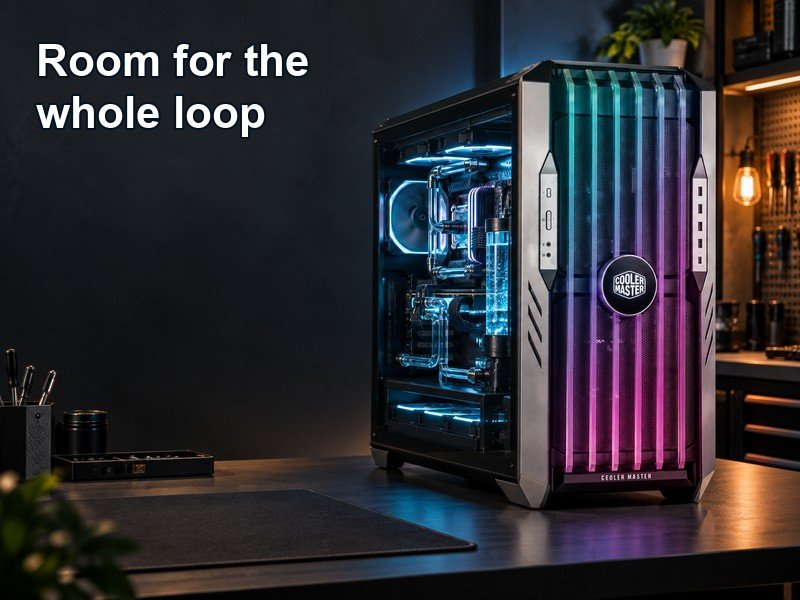
#5 — Cooler Master HAF 700 EVO
The HAF 700 EVO is a statement chassis for a builder who wants the enclosure to be part of the project. Its two included 200 mm front fans and IRIS display make that intent obvious, but the more useful purchase question is whether your planned cooling system needs its unusual amount of space.
The roof supports two 360 mm radiators, and the side has a 480 mm mounting option. Those are opportunities for arranging a substantial loop, rather than a promise that every maximum-size radiator, reservoir, fan stack and fitting will fit together. Draw the complete loop before buying parts. Leave room to reach drain points and disconnect tubing when maintenance becomes necessary.
This is also the case where measuring the room matters most. Its exterior including protrusions is 666 × 291 × 626 mm. Measure the surface, the route into the room and access around the case. Choose the original black HAF 700 EVO when you want the display and large cooling canvas; check the exact model rather than assuming the 2025 version is interchangeable.
02
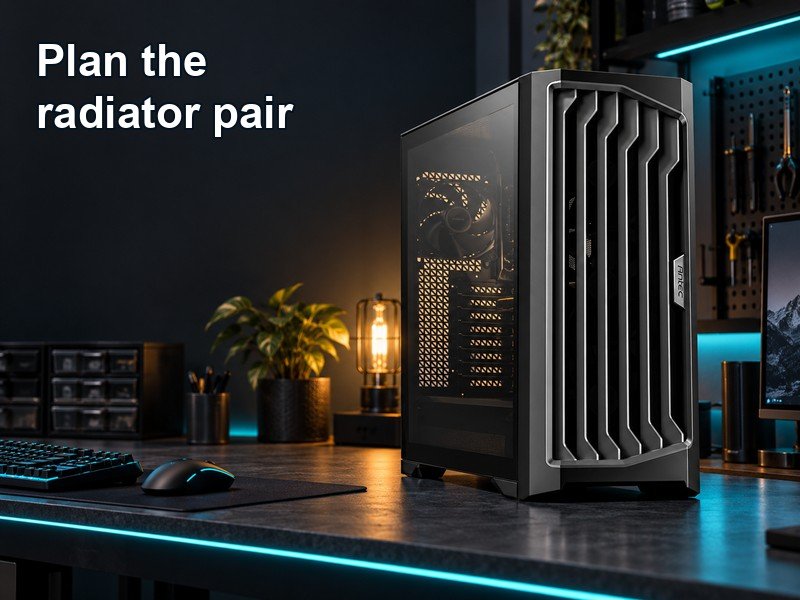
#4 — Antec Performance 1 FT
The Performance 1 FT earns its place by offering a conventional black mesh-front layout with useful cooling capacity. It is the more manageable full-tower direction in this group, though “full tower” still calls for a real desk measurement. The front can accommodate a 420 mm radiator, which makes it attractive to someone choosing a large AIO.
The catch appears when you add a second radiator. Antec warns that a front 420 mm radiator leaves the top unable to accommodate a 360 mm radiator. Its documented paired layout is front 360 mm plus top 360 mm. That is a buying constraint worth resolving before ordering the cooler, rather than discovering it during assembly.
For a straightforward build with one large front radiator, the case makes more sense than its maximum numbers alone suggest. For a dual-radiator custom loop, begin with the supported combination and account for thickness and fittings. Pick it for a practical mesh-front full tower, not because two separate mounting specifications imply an unrestricted pair.
03
#3 — Corsair 7000D Airflow
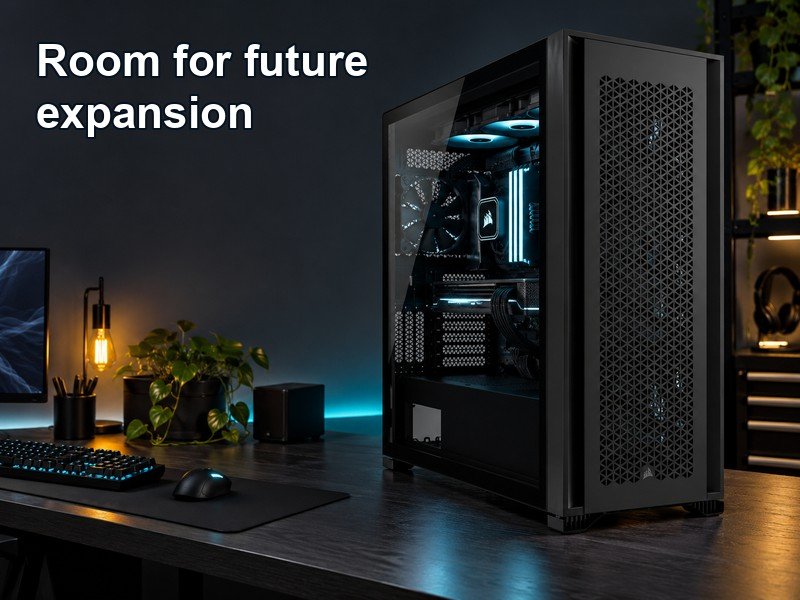
The black 7000D Airflow is the expansion-focused choice. Its perforated front and large interior give you a platform for a build that may grow, but the strongest reason to consider it is the documented set of radiator combinations. Corsair describes three simultaneous 360 mm radiators or two simultaneous 420 mm radiators.
That wording matters. A combination tells you more about a multi-radiator plan than a list of individually supported mounts. You still need to check radiator thickness, fan stacks, tubing exits and the components that occupy neighboring space. Use the build guide for the particular layout instead of treating the full-size enclosure as permission to skip planning.
It is a good direction for someone who wants substantial cooling options and later expansion without making a glass-front showcase the main priority. The tradeoff is its considerable footprint and height. Set aside space for access as well as for the bare chassis, and decide whether the planned expansion justifies the size before committing.
04
#2 — Lian Li O11D EVO XL White
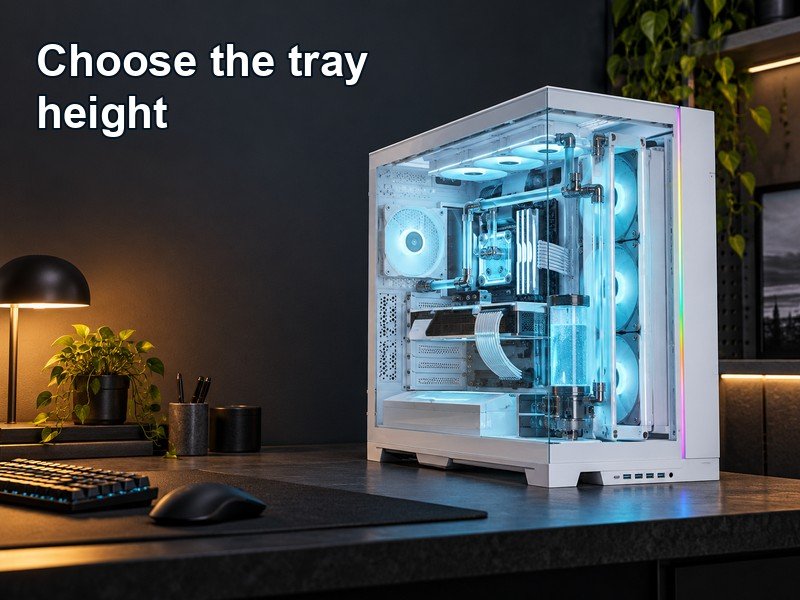
The white O11 Dynamic EVO XL suits a build where the loop and internal layout are part of what you want to see. Its glass-front presentation and removable front pillar create an open view, while the adjustable motherboard tray gives the builder a more useful mechanical choice: three height positions.
Choose the tray position early. Moving the motherboard changes the room available above and below it, so a decision made for appearance can affect radiator thickness, fittings and the path of tubing. The case supports 420 mm radiator positions at the top, side and bottom, but each complete arrangement still deserves a clearance check. Position the actual motherboard, graphics card and cooling hardware in the plan together.
This is the custom-loop showcase pick rather than the easiest route to a complete airflow package. Treat the fan arrangement as part of the build budget and plan how air enters and leaves the glass-front enclosure. It rewards deliberate layout work; it is less compelling when you simply want to install components and rely on a conventional front intake.
05
#1 — Antec Flux Pro
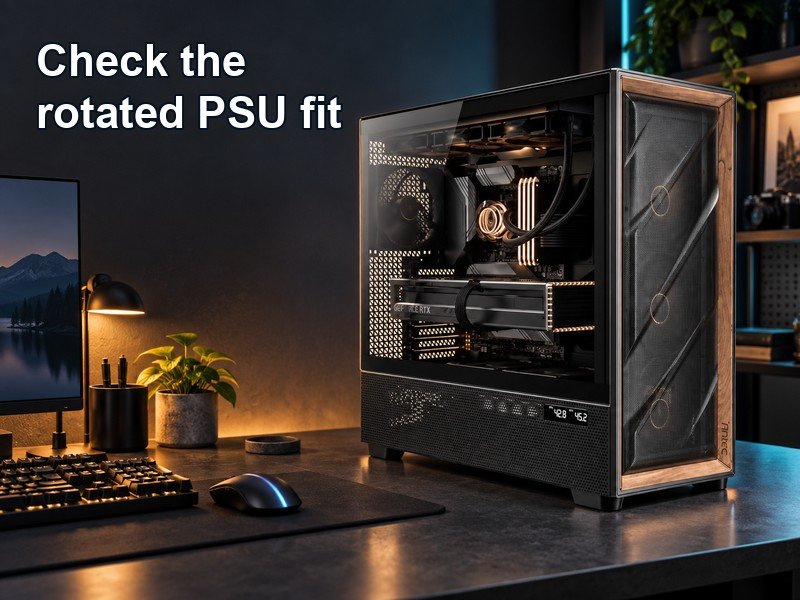
The black Flux Pro is our complete-airflow-package pick because its included hardware is unusually useful. The six PWM fans comprise three 140 mm front fans, two reverse 120 mm fans on the PSU shroud and a 140 mm rear fan. That gives a builder a meaningful starting airflow arrangement before choosing optional extra fans.
The iShift PSU system deserves attention before you buy. Its optional 90-degree orientation uses the included extension cable and opens more of the lower intake area, but that side-mounted arrangement supports a PSU body up to 180 mm long. Check the body length and connection layout of your exact supply, and allow for installation and cable routing. Do not use a larger conventional-mount allowance to justify an oversized supply in the rotated layout.
Cooling combinations also have a limit: Antec documents top 420 mm plus front 360 mm, or front 420 mm plus top 360 mm. The walnut-edged mesh front is an aesthetic benefit, but the stronger buying argument is the included fan package and deliberate lower intake. Pick it when those advantages suit your parts, with PSU fit checked first.